
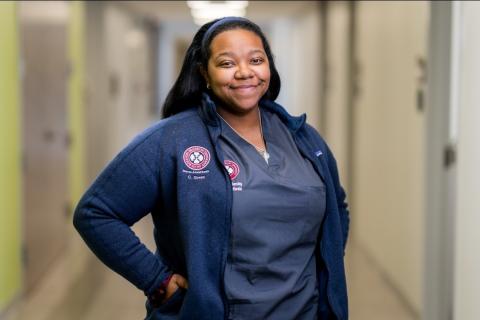
Casey Green has always had a strong urge to help people. It started with watching her grandma, who worked as a nurse when she was growing up, and was solidified for her when she was in high school and experienced a classmate having an anaphylactic reaction. Everyone else who witnessed the incident was hesitant to use the girl’s EpiPen, but Casey jumped into action, read the instructions, and helped administer the shot.
“I think in that moment I was like ‘okay, I feel pulled to help people in these situations and not run,’ so this is what I want to do,” Casey said.
Her Nursing School Journey
Casey’s nursing school journey began at a local community college, and she used NursingCAS to complete this set of applications, as well as the applications for her further degrees.
“When I was applying to schools, schools that used NursingCAS was one of the things I looked at because it was a much easier way to organize information and keep track of where I was applying.”
Being accepted into nursing school was an exciting but nerve-wracking experience. On one hand, she said, you spend so much time and energy doing the prerequisites and applications, but to actually achieve the goal you’ve been working toward for so long is surreal.
One aspect of nursing school that Casey liked the most was being part of a community of nursing students. Everyone there is working toward the same goal, so they all know what each other is going through and can share that experience. The hardest part? The sheer amount of information that students have to learn and the understanding that everything they learn will be important to care for someone one day.
“You kind of feel like you have to learn every single thing, but then the nicest part was having people that become really good friends with you along the way,” she said. “I will say, for me, that the nicest thing is all the support and friendship you have along the way.”
A Fulfilling Nursing Career
Casey officially began her career as an emergency and intensive care nurse. She knew she wanted to work in an ICU to be prepared to go to CRNA school in the future. She was looking for workplaces that were friendly to new graduates and enjoyed the rush of working in an ER. From there, she went on to do critical care and ground transport nursing, and also served as a volunteer firefighter and paramedic. She eventually continued her education to earn a master’s degree and later worked as an assistant nurse manager in an ICU, as well as a clinical instructor.
“I’ve lived a lot of nursing lives, but I also feel like with all of that it’s really prepared me well for being in nurse anesthesia school,” she said. “Having a master’s degree opened doors to education and leadership because I did a dual degree in leadership and education. All of those things have allowed me to further my nursing career.”
Attending nurse anesthesia school was Casey’s goal from the beginning, and she’s currently attending Rosalind Franklin University’s DNP nurse anesthesia program. In addition to working as a nurse anesthetist, she is also interested in pursuing education later as a nurse anesthesia educator.
Advice for New Nursing Students
For prospective nursing students, Casey’s biggest advice is to remember your why. Nursing school can be stressful, but she says the most important thing is to stay organized and remember why you’re in nursing school—because that’s the reason you’ll stay in it.
Additionally, talk to others about their experience and learn from them. Find out what their highs and lows were and ask them about what keeps them going in the field. The reasons may surprise and inspire you.
“I think, honestly, it’s seeing and feeling that I can make a difference and then inspiring other people to feel the same way and want to make healthcare, nursing education, and support for nursing students better.”